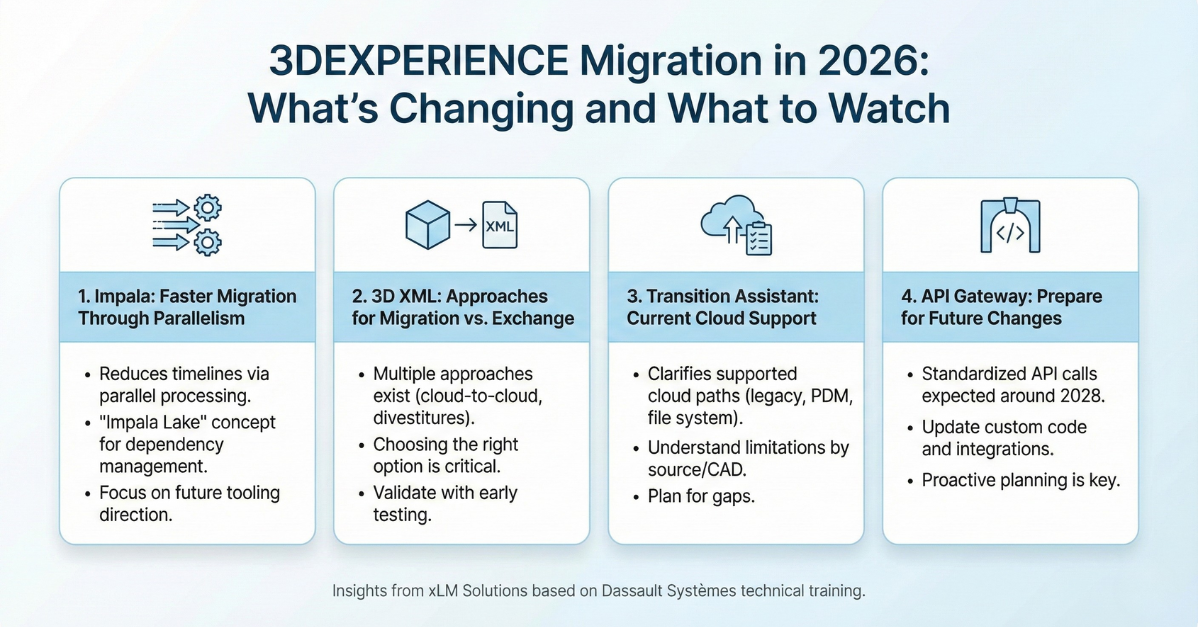
Late November, I attended a Dassault Systèmes technical training in Boston focused on migration, openness (web services) and supporting tools and methodologies. It was a pleasure to join the event and catch up with other Dassault technical partners and system integrators – many of which we’ve known and collaborated with for years.
A lot of the content reinforced what we already apply with customers day-to-day: data cleanup, testing strategy, phased execution and the realities of migrating complex product structures. That said, there were a few areas worth highlighting because they signal where the platform is heading and what customers should plan for.
Below are four takeaways I expect to be most relevant to teams planning a 3DEXPERIENCE transition, a cloud move, or any initiative that touches integration and customization.
1) Impala: Exploring Faster Migration Through Parallelism
One interesting session introduced Impala, an internal migration tool developed by a Dassault Systèmes team. While not positioned as a broadly available product as in the case of the Transition assist (on-cloud) or EDAT (on-premise) , Impala was presented as an example of how Dassault is thinking about reducing migration timelines through greater parallelism and orchestration.
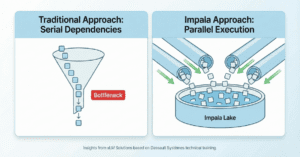
Traditional migration approaches are often constrained by dependency order: if an assembly depends on sub-components, those components must exist before the assembly can be loaded. Even with batching, this “bottom-up” requirement limits how much work can run in parallel and can significantly extend cutover windows.
Impala’s approach – described using a concept referred to as an “Impala Lake” – is designed to reduce those dependency bottlenecks and improve throughput. The tool includes orchestration and visibility features intended to manage large-scale migrations more efficiently. Overall, it’s a strong signal of where Dassault’s migration tooling may head in the future.
xLM Insight: Understanding tools like Impala is less about adopting them immediately and more about recognizing where Dassault is investing to reduce migration risk and timelines. In practice, we help customers decide when established paths such as EDAT, Transition Assist, or custom frameworks are the right fit – and where emerging concepts may influence longer-term strategy.
It is also worth mentioning that Impala has been implemented only in a small number of customers and it should be taken into consideration when planning to use it for migration (assume possible bug fix may delay the process).
2) 3DXML: Guidance On Approaches For Migration vs Exchange
3DXML is not new when migrating or exchanging data from one 3DEXPERIENCE platform to another, but the training provided a framework for when and how to use it, particularly for migration scenarios rather than supplier exchange.
The key point was that there are multiple approaches supported by 3DXML, and they are not equivalent. Some approaches are better suited for supplier collaboration and limited data exchange. Others were positioned as more appropriate for large-scale migration scenarios such as:
- Cloud-to-cloud or tenant-to-tenant movement
- Divestitures and system splits (projects moving to different environments)
- Post-acquisition consolidation
One of the migration-oriented options was described as relatively recent (26X timeframe). It had to do with mastership management of objects during migration.The details matter, but the high-level message is simple: choosing the wrong approach can create rework, especially when you’re migrating complex structures with CAD, metadata and relationships.
xLM Insight: In complex migration programs, selecting the right 3DXML approach early matters. We’ve seen projects slow down not because of migration tool limitations, but because the wrong option was chosen for the scenario. Validating the approach through targeted test cycles before committing to a timeline is often the difference between a controlled migration and unnecessary rework.
3) Transition Assistant: What Is Supported Today For Cloud Migration
Another useful segment provided a clearer view into what Transition Assistant currently supports for cloud migrations, and where important constraints still exist.
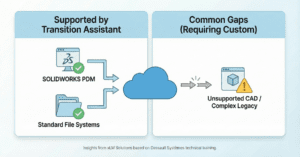
At a high level, Transition Assistant was presented as supporting several common cloud migration paths, with specific limitations based on source system and CAD type, including:
- Selected legacy system migrations into 3DEXPERIENCE cloud environments (with support limited to specific CAD configurations depending on the source)
- SOLIDWORKS PDM migrations
- Designer Central to UPS (Unified Product Structure) transitions
- File system to cloud migrations for supported CAD types
- ENOVIA SMARTEAM migrations
The practical takeaway is that support coverage still varies by both source system and CAD, and some scenarios continue to require custom migration approaches or alternative methods. In the training, this distinction between “what’s supported today” and “what’s coming” was discussed explicitly – which is the right way to plan cloud migration programs and avoid surprises during execution.
How this shows up in real projects: Cloud migrations rarely fail because teams choose the “wrong” tool – they fail because assumptions about support don’t match reality. Aligning the migration approach to what is actually supported in the current release, and planning explicitly for the gaps, is key to avoiding surprises late in execution. We talk more about preparing data for Transition Assistant in this blog.
xLM Insight: In addition to previously experimenting with the Migration Assistant Tool for SOLIDWORKS PDM to 3DEXPERIENCE migrations, xLM is currently actively working on a SMARTEAM to 3DEXPERIENCE migration. We are learning its limitations, adjusting methodologies and will be happy to assist you in such migrations.
4) API Gateway: Prepare Now for Changes That Could Impact Custom Code
For teams building custom widgets, applications, integrations, needing to augment data already loaded, or automations using REST APIs, one message stood out clearly during the training:
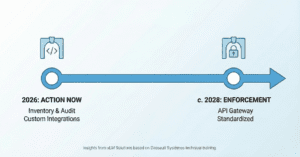
Dassault indicated it is moving toward an API Gateway model, with enforcement expected around the 2028 timeframe.
In practical terms, the way APIs are called will be standardized behind a gateway. Any custom code that assumes current endpoints (URLs) and calling patterns will need to be updated, or it risks breaking as enforcement tightens.
From a customer perspective, this is something to plan for proactively rather than discover during a future upgrade or cloud transition.
xLM insight: API changes are easy to overlook until they become upgrade blockers. Teams that inventory custom integrations and widgets early – and understand where API usage will need to evolve – are far better positioned to adapt without disruption as enforcement approaches.
Closing Thought: The Value Of Training Is Reducing Risk In Execution
The most important part of sessions like this is alignment: Dassault is standardizing guidance and tooling around the same migration and integration realities we see with customers, and it’s useful to compare what’s recommended with what works in real programs. In addition we learned from experience that it is not just about the tools, it is also about methodologies around the tools. This is where xLM has decades of experience.
If you are planning a migration, a cloud move, a divestiture, or an acquisition scenario, the best first step is often a short technical assessment: confirm what tools fit, identify constraints early, then build the plan around testing and data readiness.
Planning a 3DEXPERIENCE migration or cloud transition? Talk to xLM about the right tools, timeline and risk plan.
